Free guide · 38 pages
Is your next study breaking the rules?
Removing names, AI moderators, emotion scoring - the GDPR and the EU AI Act reach further into everyday research than most teams realize.
Sound familiar?
Chapter 4
You took the names out of the transcript.
Job title, employer and city still point to one person. It's still personal data.
Chapter 6
Your AI moderator jumps straight to question one.
Since August 2026 it has to say it's an AI. A line in your terms won't cover it.
Chapter 6
You score frustration from voice or face.
At work, candidate interviews included, that has been banned since February 2025.
Chapter 2
One checkbox covers the recording, the clips and your panel.
Each purpose needs its own yes.
What's inside
- Your research data is more personal than you think
- Getting the lawful basis right
- When a participant changes their mind
- "We removed the names": anonymisation and pseudonymisation
- AI vendors in your research stack
- The EU AI Act, for people who run interviews
- What is still moving
- A checklist for your next study
- How Reos handles this, and what stays with you
From the checklist
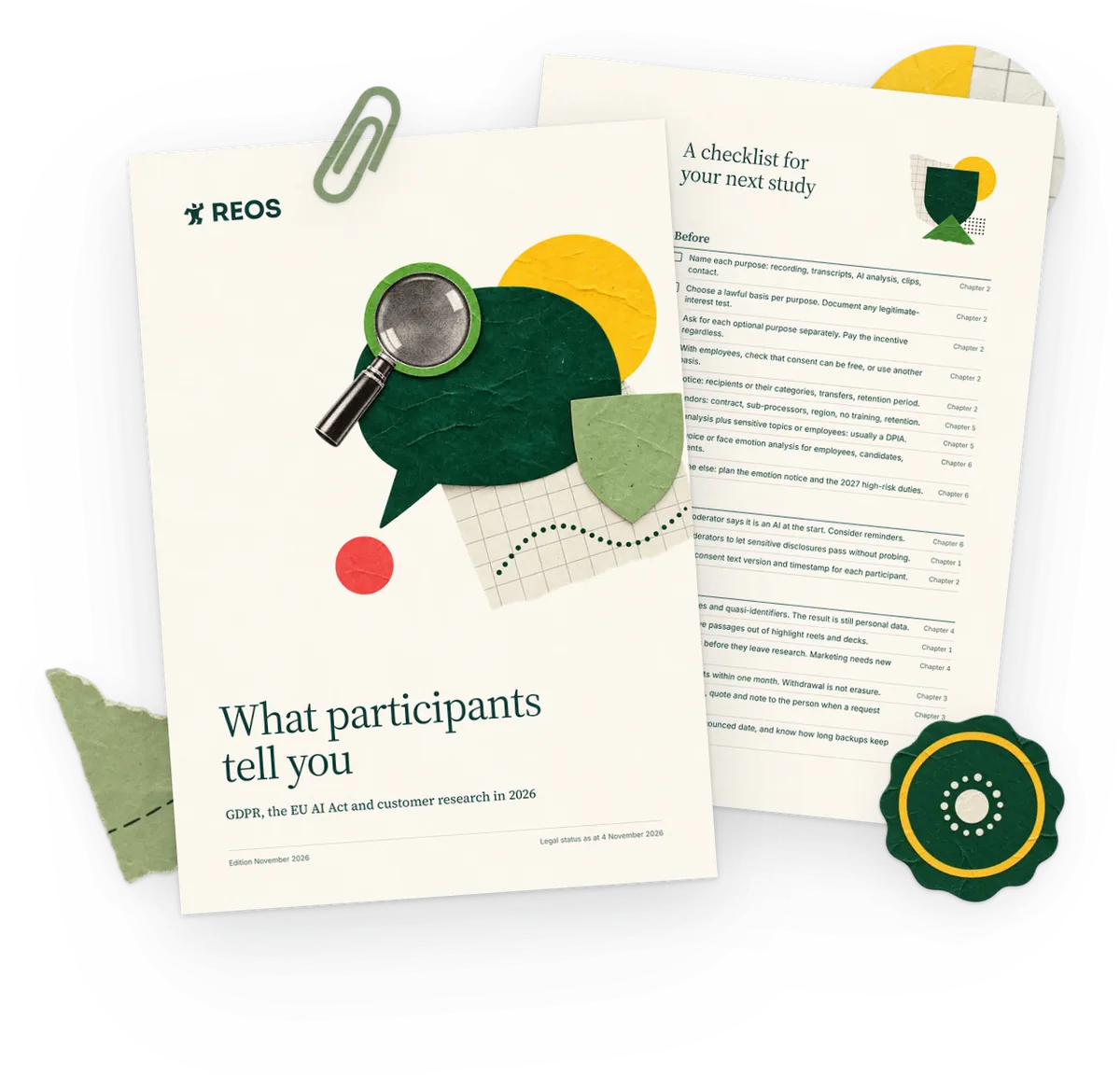
- Ask for each optional purpose separately. Pay the incentive regardless.
- Vendors: contract, sub-processors, region, no training, retention.
- An AI moderator says it is an AI at the start. Consider reminders.
- Check quotes before they leave research. Marketing needs new consent.
14 more items in the guide
Or let Reos handle it
- Consent that holds upEvery answer is stored with the exact form version the participant saw and when they said yes.
- Withdrawals without the email chainParticipants withdraw through their own link, and Reos starts no new transcription or analysis on what they withdrew.
- AI interviews that introduce themselvesThe AI interviewer is labelled as an AI before and during the session. Emotion inference is off by default.
SOC 2 Type II, ISO 27001 and ISO 42001 certified. EU or US data residency, your choice.

Before you download
- The Reos team, from 52 sources: the legal texts, court rulings and regulator guidance. Every claim was fact-checked before we published it.
- No. It explains the law as of 4 November 2026, so you know what to ask your legal team.
- Once a month we share points of view on the state of research; hands-on guides on interview techniques, methods, and AI-assisted analysis, and updates on regulations worldwide.